

You want a powerful femtosecond laser, but every quote feels like buying a small spaceship. Specs, brands, and hidden costs all blur together, and you just want clear answers before your budget evaporates.
To solve this, compare pulse energy, repetition rate, and service costs side‑by‑side, then match them to your real application needs. Use industry data, like the laser market analysis from Laser Focus World, to benchmark fair prices and avoid overpaying.
💰 Key Price Ranges for Industrial and Research Femtosecond Laser Systems
Femtosecond laser prices vary widely by power, pulse energy, and stability class. Buyers should compare not only purchase price but also lifetime operating cost.
Most projects balance budget with uptime, warranty, and integration support. Clear application goals help avoid over‑specifying or under‑specifying the system.
1. Entry-Level Research Systems
Designed for universities and basic labs, these lasers support training, spectroscopy, and prototyping where ultra-high power is not required.
- Typical price range: USD 40,000–80,000
- Average power: 0.2–1 W
- Pulse duration: 80–300 fs
- Good for optics education, nonlinear demos
2. Advanced Lab and R&D Platforms
These systems target demanding microscopy, micro‑machining tests, and nonlinear imaging where high stability and flexible tuning matter.
| Feature | Typical Value |
|---|---|
| Price range | USD 80,000–200,000 |
| Average power | 1–10 W |
| Repetition rate | 100 kHz–80 MHz |
| Use cases | Two‑photon, pump–probe, precision tests |
3. Industrial Production-Grade Systems
Built for 24/7 use in cutting, drilling, patterning, and semiconductor work, with strong thermal management and service contracts.
- Price range: USD 150,000–500,000+
- High power: 10–100+ W
- Rugged housing, sealed design
- Fast field service and remote diagnostics
4. Specialty Medical and Ophthalmic Platforms
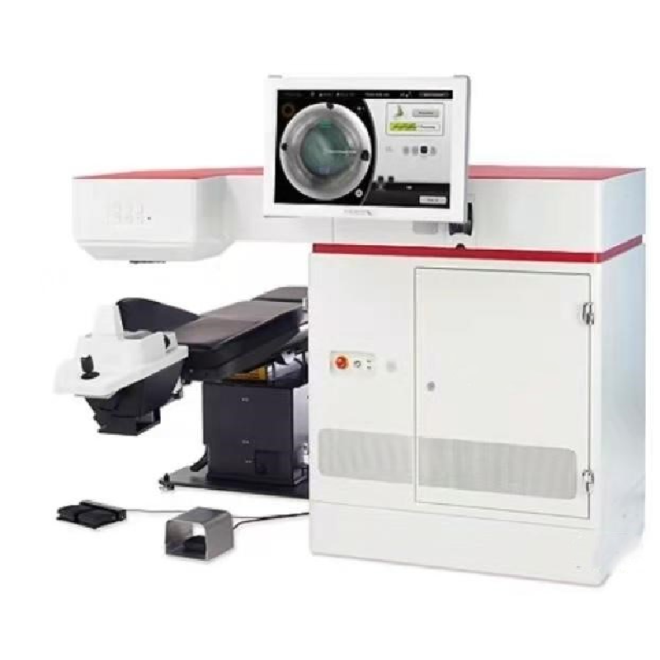
Medical femtosecond lasers, including the Femtosecond Laser Ophthalmic Treatment System, add imaging, safety layers, and regulatory approvals.
| Segment | Indicative Cost |
|---|---|
| Ophthalmic surgery | USD 300,000–700,000+ |
| Other medical uses | USD 250,000–600,000 |
| Key adders | Navigation, imaging, approvals |
🔧 Core Technical Specifications That Most Strongly Influence Femtosecond Laser Cost
Core specs such as pulse energy, average power, repetition rate, and beam quality drive both upfront price and long‑term operating value.
Understanding these factors helps buyers choose a balanced configuration instead of simply chasing the highest listed numbers.
1. Average Power and Pulse Energy
Higher power and pulse energy usually raise price but improve throughput in cutting, drilling, and surface structuring tasks.
- Power steps: 1 W, 5 W, 20 W, 50 W+
- Higher power needs better cooling
- Oversizing wastes budget and utilities
2. Pulse Duration and Temporal Stability
Shorter pulses below 100 fs often cost more yet reduce heat‑affected zones, which is critical for medical and microelectronics work.
| Pulse Duration | Cost Impact | Typical Use |
|---|---|---|
| 200–400 fs | Low–medium | General cutting |
| 80–200 fs | Medium | Micro‑machining |
| <80 fs | High | Research, delicate tissue |
3. Repetition Rate and Flexibility
Fixed repetition rates cost less, while wide tunability adds electronics, control software, and integration features.
- Fixed MHz sources: lower price, simpler setup
- Tunable kHz–MHz: higher price, more control
- Helps optimize throughput vs. thermal load
4. Data Visualization: How Specs Shift Budget
The chart below gives an example of how power class, pulse duration, and tunability can influence relative cost levels.
🏭 Application Requirements, Integration Complexity, and Their Impact on Total Budget
Real project cost depends on how the femtosecond laser fits tooling, motion systems, safety, and software in your line.
Clear process specs reduce engineering change orders and avoid costly rework after installation.
1. Simple Lab Setups vs. Full Production Lines
Benchtop labs need basic tables and safety, while factories require conveyors, vision, enclosures, and automation links.
- Lab: minimal fixtures and simple controls
- Pilot line: semi‑automated stages
- High‑volume line: PLCs, MES links, custom HMI
2. Motion Control, Optics, and Fixturing
High‑precision stages, galvo scanners, and custom jigs quickly raise system-level cost but also boost throughput and accuracy.
| Item | Typical Cost Effect |
|---|---|
| Basic XY stage | Low |
| High‑precision air bearing stage | High |
| Custom fixtures, probes | Medium–high |
3. Safety, Compliance, and Documentation
Laser safety curtains, emergency stops, interlocks, and validated software add both material and engineering expense.
- Class‑1 enclosures for factory floors
- Safety PLC and dual‑channel interlocks
- Risk assessments and user training
📈 Long-Term Ownership Costs: Maintenance, Upgrades, and Service from LumosTail
Total cost of ownership includes optics life, service calls, software updates, and planned upgrades over many years.
LumosTail focuses on predictable running costs to help buyers plan realistic budgets from the start.
1. Preventive Maintenance and Consumables
Regular checks reduce downtime and protect key components from contamination and thermal stress.
- Annual inspections and power calibration
- Filter changes and optic cleaning
- Logged service history for audits
2. Upgrade Paths and Modularity
Modular designs let you add power, scanners, or software options later, instead of replacing the full system.
| Module | Benefit |
|---|---|
| Scanner upgrade | Faster marking, finer features |
| Power upgrade | Higher throughput |
| Control software | Better recipes, traceability |
3. Remote Support and On-Site Service
Fast diagnostics shorten downtime and protect your investment while keeping your process stable.
- Remote troubleshooting to cut travel delays
- On-site repair by trained engineers
- Service contracts with fixed annual cost
🧪 Balancing Performance, Reliability, and Budget with LumosTail Femtosecond Lasers
Choosing a femtosecond laser is a balance between desired specs, integration effort, and realistic budget over the full life cycle.
LumosTail works with users to match system class, service plan, and upgrade plans to each application.
1. Defining Must-Have vs. Nice-to-Have Specs
Focus your budget on parameters that truly affect your process, such as cut quality, cycle time, and uptime.
- Rank specs by real process impact
- Avoid paying for unused tuning ranges
- Plan for future needs but stay grounded
2. Reliability and Uptime as Hidden Value Drivers
Stable operation often saves more money than a small discount on the initial purchase.
| Factor | Effect |
|---|---|
| MTBF | Less unplanned downtime |
| Spare part access | Faster recovery |
| Training | Fewer user errors |
3. Tailored Solutions for Industry and Research
LumosTail helps research teams, OEMs, and factories specify systems that meet targets without overspending.
- Application trials and sample runs
- Joint process development
- Clear upgrade roadmaps for growth
Conclusion
Femtosecond laser price depends on power, pulse width, reliability, and how deeply the system integrates into your workflow. Smart buyers look beyond sticker price to total lifetime value.
By understanding key cost drivers and working with a partner like LumosTail, you can select a femtosecond laser that supports both today’s jobs and future growth.
Frequently Asked Questions about femtosecond laser
1. What is a femtosecond laser?
A femtosecond laser emits extremely short light pulses, each lasting around 10⁻¹⁵ seconds. These pulses allow very precise cutting, drilling, and imaging with minimal heat damage.
2. Why are femtosecond lasers more expensive than standard lasers?
They need advanced optics, tight thermal control, and stable electronics to create and repeat ultra‑short pulses. This complexity, plus integration and support, raises system cost.
3. How long does a femtosecond laser typically last?
With proper maintenance, many systems run reliably for 7–10 years or more. Lifetime depends on operating hours, environment, and adherence to service schedules.
4. Can I upgrade power or features later?
Many modern platforms allow power, scanner, and software upgrades. Ask vendors about modular designs, supported paths, and how upgrades affect warranty and validation.
5. What industries use femtosecond lasers most?
Common users include semiconductor manufacturers, medical device makers, ophthalmic surgery centers, research labs, and precision engineering firms needing fine features and low thermal damage.